
Meta title: Clipping CAC: Customer Acquisition Cost for Clipping Campaigns
Meta description: Learn how to calculate true CAC from clipping campaigns and compare clipping CAC against paid ads, influencer marketing, SEO, affiliates, and other growth channels.
Suggested URL slug: /blog/clipping-cac-customer-acquisition-cost
Primary keyword: clipping CAC
Secondary keyword: customer acquisition cost clipping campaigns
Audience: Founders, performance marketers, agencies, CMOs, growth leads, SaaS teams, creator economy operators
Search intent: Commercial investigation / comparison
Recommended CTA: Get a Free Distribution Audit
Recommended internal links:
| Anchor text | Suggested target |
|---|---|
| How Much Does Clipping Cost? | /blog/how-much-does-clipping-cost-a-complete-guide-for-creators-brands |
| The Complete Guide to Clipping in 2026 | /blog/the-complete-guide-to-clipping-in-2026 |
| What Is Creator-Powered Distribution? | /blog/what-is-creator-powered-distribution |
| Multi-Touch Attribution Models for Clipping Campaigns | /blog/clipping-campaign-attribution |
| Brand Lift & Sentiment Measurement from Clipping Campaigns | /blog/brand-lift-clipping-campaign |
| Clipping vs. Influencer Marketing ROI | Recommended new comparison page |
| Paid Clipping Campaigns Ultimate Guide | Recommended new pillar page |
Featured Image Prompt
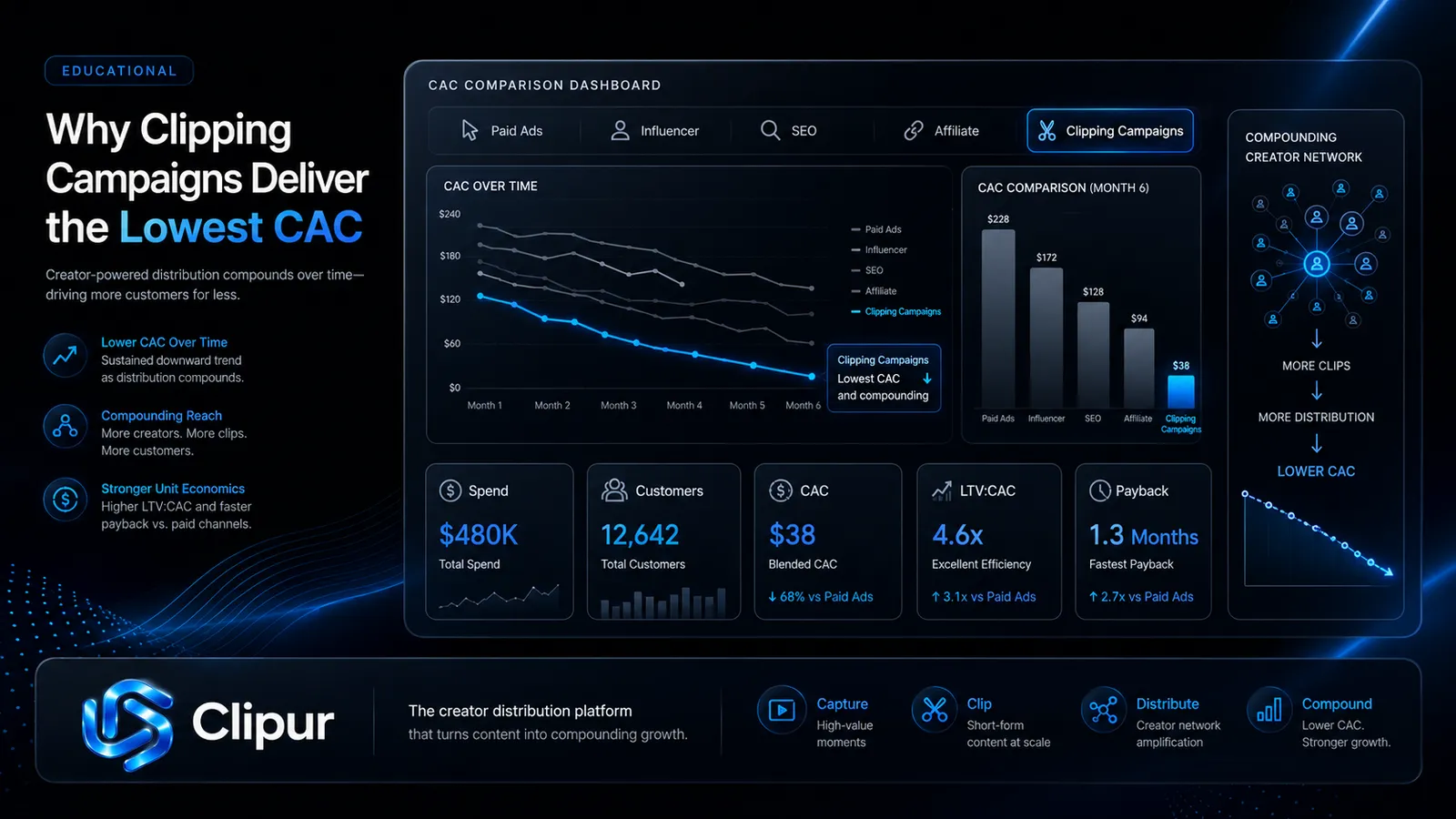
Dark, premium Clipur educational blog hero. Near-black background with electric-blue and cyan gradients. Center visual: CAC comparison dashboard showing “Paid Ads,” “Influencer,” “SEO,” “Affiliate,” and “Clipping Campaigns.” Clipping line trends downward with lower CAC and compounding creator distribution. Include glassmorphism cards for “Spend,” “Customers,” “CAC,” “LTV:CAC,” and “Payback.” Metallic blue Clipur icon in footer. Clean SaaS financial dashboard aesthetic. No purple.
Calculating True Customer Acquisition Cost via Clipping vs. Other Channels
Most companies calculate customer acquisition cost too simply.
They take campaign spend, divide it by new customers, and call that CAC.
That works for basic reporting.
It fails when comparing clipping campaigns against paid ads, influencer marketing, SEO, affiliates, events, and outbound sales.
A clipping campaign does not behave like one ad campaign or one creator sponsorship. It creates distributed content, creator posts, social proof, search demand, direct traffic, retargeting audiences, and long-tail discoverability.
If you only measure the customers who convert immediately from a tracked link, clipping can look weaker than it really is.
If you count every future customer as clipping-driven, clipping can look stronger than it really is.
The correct answer sits in the middle.
To calculate true clipping CAC, marketers need to separate direct CAC, assisted CAC, blended CAC, and incremental CAC.
This guide explains how.
Direct Answer: What Is Clipping CAC?
Clipping CAC is the total cost required to acquire a customer through a clipping campaign, including campaign spend, creative preparation, creator payouts, campaign management, analytics setup, sales follow-up, and any supporting media costs.
The basic formula is:
Clipping CAC = Total clipping acquisition cost / New customers acquired from the campaign
A more accurate formula is:
True clipping CAC =
Campaign spend + creative costs + management costs + tracking costs + sales follow-up costs
/
Direct customers + attributable assisted customers
For advanced teams, the best model is:
Incremental clipping CAC =
Total clipping campaign cost
/
Customers who would not have been acquired without the campaign
That final version is the most accurate, but it requires baselines, attribution, and incrementality testing.
Standard CAC Formula
HubSpot defines customer acquisition cost as the total sales and marketing cost divided by the number of new customers acquired during the same period. Its startup CAC formula is: CAC = cost of sales + cost of marketing / number of new customers. (HubSpot)
That formula is useful.
But for clipping campaigns, it needs more detail because clipping creates both direct and indirect demand.
A buyer might:
- See a creator clip on X
- Watch a second clip on TikTok
- Search the brand name
- Visit the website directly
- Read a case study
- Book a call from a retargeting ad
- Convert after a sales follow-up
If you only credit the final click, you undercount the clipping campaign.
If you credit the full sale to clipping, you overcount it.
That is why clipping CAC should be calculated in layers.
The Four Types of CAC You Need to Separate
1. Direct Clipping CAC
Direct clipping CAC only counts customers who came from tracked campaign links, creator links, promo codes, or campaign landing pages.
Direct clipping CAC =
Total clipping campaign cost / Direct customers from clipping
Best for:
- E-commerce
- Self-serve SaaS
- Whop offers
- Course launches
- Crypto campaigns
- App installs
- Low-friction signup flows
Weakness:
It misses branded search, direct traffic, dark social, retargeting influence, and sales-assisted conversions.
2. Assisted Clipping CAC
Assisted clipping CAC counts customers where clipping was part of the journey but not necessarily the final click.
Assisted clipping CAC =
Total clipping campaign cost / Direct + assisted customers
Best for:
- B2B SaaS
- Agencies
- enterprise sales
- fintech
- high-consideration products
- founder-led campaigns
Weakness:
It requires CRM tracking, self-reported attribution, and multi-touch attribution.
3. Blended CAC
Blended CAC divides total acquisition spend across all new customers.
Blended CAC =
Total sales and marketing spend / Total new customers
This is useful for company-level efficiency.
It is not useful for comparing individual channels.
If SEO, referrals, direct traffic, paid search, and clipping all contribute to growth, blended CAC can hide which channels are actually efficient.
4. Incremental CAC
Incremental CAC asks the hardest and most important question:
How many customers did clipping create that we would not have acquired otherwise?
Incremental clipping CAC =
Total clipping campaign cost / Incremental customers created
Best for:
- mature growth teams
- larger campaign budgets
- enterprise reporting
- channel budget allocation
- board-level marketing analysis
Weakness:
It requires pre/post baselines, holdouts, geo tests, or controlled comparisons.
Why CAC Comparison Is Usually Wrong
Most CAC comparisons are unfair because teams compare visible costs in one channel against hidden costs in another.
Example:
A founder may say:
“Google Ads CAC is $180. Clipping CAC is $250. Google is better.”
But that may ignore:
- creative production
- landing page costs
- agency fees
- media buying labor
- attribution gaps
- retargeting support
- brand search created by clipping
- sales conversations influenced by social proof
- long-tail content value from creator posts
The better question is not:
“Which channel had the cheapest last-click CAC?”
The better question is:
“Which channel acquired the highest-quality customers at the lowest fully loaded acquisition cost?”
True CAC Formula for Clipping Campaigns
Use this full formula:
True clipping CAC =
Creator payouts
+ platform fees
+ campaign strategy
+ creative preparation
+ editing or source-content costs
+ creator management
+ analytics setup
+ landing page creation
+ sales follow-up labor
+ retargeting support
+ compliance review
/
New customers attributed or influenced
For a simpler operator dashboard:
True clipping CAC =
Total campaign cost + internal labor cost + supporting channel cost
/
Direct customers + assisted customers
Hidden Costs to Include in CAC
Most channels look cheaper when hidden costs are ignored.
| Cost category | Paid ads | Influencer marketing | SEO/content | Clipping campaigns |
|---|---|---|---|---|
| Media spend | High | Medium / high | Low / medium | Medium |
| Creative production | Medium | Medium | High upfront | Medium |
| Management labor | Medium | High | High | Medium |
| Distribution cost | High | Included in fee | Slow / organic | Performance-driven |
| Tracking setup | Medium | Medium | Medium | Medium |
| Sales follow-up | Medium | Medium | Medium | Medium |
| Long-tail value | Low / medium | Medium | High | High |
| Brand lift | Medium | Medium / high | Medium | High |
| Creator/social proof | Low | High | Low | High |
| Compounding discoverability | Low | Medium | High | High |
The major difference with clipping is that one campaign can create many reusable distribution assets across many creator accounts.
Clipur’s cost guide makes this distinction directly: most brands underestimate clipping costs because they focus on editing instead of distribution, and creator-powered distribution changes the economics by combining clipping, creator incentives, campaign management, performance tracking, and distribution. (Clipur)
CAC Benchmarks: Directional Context for 2026
Benchmarks should be treated as directional, not absolute.
CAC changes based on:
- average contract value
- sales cycle
- vertical
- offer quality
- landing page conversion rate
- brand trust
- pricing
- geography
- funnel maturity
- retargeting
- sales execution
- attribution method
Still, benchmarks help frame the comparison.
Paid Search
LocaliQ’s 2026 search advertising benchmark report found that average CPC varies heavily by industry, with some low-cost categories such as Arts & Entertainment and Restaurants & Food near the low end, while competitive categories trend much higher. (LocaliQ)
WordStream’s 2025 Google Ads benchmarks reported that average cost per lead across industries increased from $66.69 in 2024 to $70.11 in 2025. (WordStream)
That is cost per lead, not CAC.
If only 10–25% of leads become customers, actual paid search CAC can be several multiples higher.
Paid Social
LocaliQ’s Facebook Ads benchmark reported an average cost per lead of $27.66 for lead campaigns across industries in 2025. (LocaliQ)
Again, this is CPL, not CAC.
A low CPL campaign can still produce expensive CAC if lead quality is poor.
SaaS CAC
Stripe notes that CAC for small and middle-market B2B SaaS often ranges from $300 to $5,000 depending on subindustry and sales complexity. (Stripe)
First Page Sage’s B2B SaaS CAC benchmark lists significant variation by vertical, including examples such as eCommerce SaaS at $274, engineering SaaS at $551, education SaaS at $806, fintech SaaS at $1,450, insurance SaaS at $1,280, and medtech SaaS at $921. (First Page Sage)
This matters because clipping CAC should not be judged against a universal number.
A $300 CAC may be expensive for a low-ticket consumer product and excellent for a $20,000 annual SaaS contract.
Directional CAC Benchmarks by Vertical
Use this table as a planning framework, not a universal benchmark.
| Vertical | Typical CAC pressure | Why CAC is expensive | Where clipping can help |
|---|---|---|---|
| B2B SaaS | Medium to high | Long sales cycles, competitive search, multiple decision-makers | Founder-led clips, product education, social proof |
| Fintech | High | Trust, compliance, risk perception, high-value customers | Educational clips, authority building, repeated exposure |
| Crypto / Web3 | Variable | Narrative cycles, community trust, launch timing | Community distribution, X-native attention, meme velocity |
| E-commerce | Low to medium | Paid social competition, creative fatigue | UGC-style clips, product demos, social proof |
| Online education | Medium | Trust, proof of expertise, long consideration | Instructor clips, student outcomes, topic authority |
| Fitness / wellness | Medium | Trust, differentiation, visual proof | Transformation clips, educational clips, creator testimonials |
| Podcasts / media | Low to medium | Monetization depends on audience growth | Audience acquisition, subscriber growth, long-tail discovery |
| Agencies | Medium to high | Differentiation, trust, proof, founder reputation | Case study clips, founder POVs, client proof |
| Events / livestreams | Medium | Short conversion windows, urgency | Countdown clips, speaker clips, FOMO distribution |
The main CAC advantage of clipping is not that every view converts immediately.
It is that distributed short-form content can reduce future acquisition friction.
People who have seen the brand repeatedly are easier to retarget, easier to convert through search, easier to sell, and more likely to trust the offer.
Clipping CAC vs. Other Channels
| Channel | Typical CAC profile | Strength | Weakness |
|---|---|---|---|
| Paid search | High intent, often expensive | Captures existing demand | Limited demand creation |
| Paid social | Scalable but creative-dependent | Fast testing | Creative fatigue, rising costs |
| Influencer marketing | Trust-driven but inconsistent | Borrowed credibility | High upfront fees, variable tracking |
| SEO/content | Compounding but slow | Durable organic acquisition | Slow feedback loop |
| Affiliate marketing | Performance-aligned | Pay for outcomes | Requires strong partner network |
| Events/webinars | High-intent leads | Strong trust and education | Labor-heavy |
| Outbound sales | Direct targeting | Good for enterprise | Expensive labor and low response rates |
| Clipping campaigns | Distributed attention + social proof | Many creators, many assets, performance-based reach | Requires strong creative, tracking, and campaign ops |
Clipur’s creator-powered distribution guide explains the core difference between traditional influencer marketing and creator-powered distribution: influencer marketing typically relies on a small number of creators, while creator-powered distribution uses larger networks of creators to generate more content, distribution opportunities, social proof, and discoverability. (Clipur)
That distinction matters for CAC.
Influencer marketing often concentrates spend into one creator.
Clipping distributes spend across many creators and many content variations.
When Clipping Wins on CAC
Clipping campaigns usually have the strongest CAC advantage when five conditions are true.
1. The Product Needs Education
If the market does not immediately understand the product, clipping helps.
Examples:
- AI tools
- SaaS platforms
- crypto protocols
- creator tools
- fintech products
- agencies
- online education
- complex consumer products
Short-form clips can explain the product from multiple angles.
Each creator becomes a different education channel.
2. The Founder or Brand Has Strong Source Content
Clipping works best when there is something worth clipping.
Strong source assets include:
- podcasts
- founder interviews
- product demos
- webinars
- livestreams
- customer stories
- case studies
- conference talks
- educational breakdowns
Weak source content creates weak clips.
Weak clips create poor CAC.
3. Social Proof Matters
Clipping can reduce CAC when buyers need to see that other people are talking about the brand.
This is especially important for:
- startups
- SaaS
- Web3
- agencies
- creator tools
- financial education
- events
- online communities
A single ad says:
“We are worth paying attention to.”
A distributed clipping campaign says:
“People are already paying attention.”
That difference can change conversion behavior.
4. Paid Ads Are Getting Expensive
Paid ads are auction-based.
As more competitors bid on the same audiences and keywords, costs rise.
Clipping is not immune to competition, but it is not purely dependent on ad auctions.
The channel can win when:
- search CPC is too high
- paid social creative is fatigued
- influencer fees are too expensive
- organic brand accounts have limited reach
- the company needs repeated exposure across social platforms
5. The Campaign Creates Long-Tail Assets
A paid ad disappears when spend stops.
A creator post can remain searchable, shareable, and discoverable.
This is especially valuable on:
- YouTube Shorts
- TikTok search
- X search
- AI search engines
- community forums
- social screenshots
The long-tail value is not always captured in direct CAC, but it affects blended acquisition cost over time.
When Clipping Does Not Win on CAC
Clipping is not automatically cheaper.
It can lose when:
- the offer is weak
- the landing page does not convert
- the source content is boring
- the hook angles are unclear
- creators are poorly matched
- tracking is not set up
- the audience is too broad
- the product has low LTV
- the brand has no follow-up system
- the campaign is judged only by immediate last-click conversions
A clipping campaign is a distribution engine.
It cannot fix a broken offer.
Example: Direct Clipping CAC Calculation
Assume a SaaS company spends $10,000 on a clipping campaign.
Campaign Output
| Metric | Result |
|---|---|
| Campaign spend | $10,000 |
| Creator posts | 180 |
| Verified views | 1,500,000 |
| UTM sessions | 8,000 |
| Signups | 640 |
| Paid customers from tracked links | 32 |
Direct CAC
Direct CAC = $10,000 / 32
Direct CAC = $312.50
If the product has a $1,500 annual gross profit per customer, the campaign has a strong direct CAC profile.
But this still ignores assisted customers.
Example: Assisted Clipping CAC Calculation
Now assume the same campaign also produces:
| Assisted signal | Result |
|---|---|
| Branded search lift | +41% |
| Direct traffic lift | +28% |
| CRM leads mentioning clips | 22 |
| Customers influenced but not last-click attributed | 18 |
Assisted CAC
Assisted CAC = $10,000 / (32 direct customers + 18 assisted customers)
Assisted CAC = $10,000 / 50
Assisted CAC = $200
The direct CAC is $312.50.
The assisted CAC is $200.
Neither number is “the truth” by itself.
Together, they show the range.
Example: B2B Pipeline CAC
For a higher-ticket company, customer count may not be the best first metric.
Pipeline may matter more.
Assume:
| Metric | Result |
|---|---|
| Campaign cost | $15,000 |
| Qualified leads | 75 |
| Opportunities created | 12 |
| Customers closed | 3 |
| Average annual contract value | $18,000 |
| Gross margin | 80% |
Customer CAC
Customer CAC = $15,000 / 3
Customer CAC = $5,000
At first glance, $5,000 CAC looks expensive.
But if annual gross profit per customer is:
$18,000 × 80% = $14,400
Then first-year gross profit is almost 3x CAC.
If customers retain beyond one year, the economics improve further.
For B2B, CAC must be judged against LTV, gross margin, and payback period.
Example: Low-Ticket Consumer CAC
Assume an e-commerce brand spends $5,000.
| Metric | Result |
|---|---|
| Campaign spend | $5,000 |
| Purchases | 250 |
| Average order value | $38 |
| Gross margin | 55% |
| Gross profit per order | $20.90 |
CAC
CAC = $5,000 / 250
CAC = $20
This looks profitable on the first purchase because gross profit per order is $20.90.
But if fulfillment, returns, discounts, and payment fees reduce margin, the campaign may only break even.
For consumer brands, clipping CAC should be evaluated against:
- first-order profit
- repeat purchase rate
- subscription conversion
- email/SMS capture
- customer lifetime value
CAC Payback for Clipping Campaigns
CAC is incomplete without payback.
CAC payback period =
CAC / monthly gross profit per customer
Example:
| Metric | Value |
|---|---|
| CAC | $300 |
| Monthly revenue per customer | $100 |
| Gross margin | 80% |
| Monthly gross profit | $80 |
| CAC payback | 3.75 months |
A $300 CAC is good if the customer produces $80/month in gross profit.
It is bad if the customer produces $15/month in gross profit.
The channel does not determine whether CAC is good.
The unit economics do.
LTV:CAC Ratio for Clipping
A common growth benchmark is to aim for at least a 3:1 LTV:CAC ratio, though the right target depends on margin, retention, payback, and company stage.
LTV:CAC = Customer lifetime value / Customer acquisition cost
Example:
| Metric | Value |
|---|---|
| LTV | $1,200 |
| Clipping CAC | $300 |
| LTV:CAC | 4:1 |
This is healthy.
But if the same campaign produces:
| Metric | Value |
|---|---|
| LTV | $150 |
| Clipping CAC | $300 |
| LTV:CAC | 0.5:1 |
The campaign is not viable unless it creates meaningful brand, audience, or strategic value beyond immediate customer acquisition.
Hybrid Models: Where Clipping Becomes Most Efficient
Clipping often performs best when paired with another channel.
1. Clipping + Retargeting
Use clips to create awareness.
Use paid retargeting to capture intent.
Best for:
- SaaS
- e-commerce
- events
- online education
- fintech
- creator tools
Why it works:
The clipping campaign warms the audience. Retargeting converts them.
2. Clipping + Founder-Led Sales
Use clips to build founder trust.
Use outbound or inbound sales to convert high-intent buyers.
Best for:
- B2B SaaS
- agencies
- services
- enterprise tools
- high-ticket offers
Why it works:
Prospects who have already seen the founder are less cold.
3. Clipping + SEO / GEO
Use clips to create social proof and search demand.
Use articles, case studies, and comparison pages to capture research intent.
Best for:
- AI tools
- SaaS
- creator economy companies
- education brands
- technical products
Why it works:
Social distribution creates demand. Search content captures demand.
4. Clipping + Influencer Anchor Post
Use one major creator as the anchor.
Use clipping to distribute the best moments through many smaller creators.
Best for:
- product launches
- podcasts
- event campaigns
- creator collaborations
- crypto launches
Why it works:
The influencer creates the source moment. Clippers create distribution density.
5. Clipping + Affiliate / Referral
Use clipping to generate attention.
Use affiliate links, referral codes, and creator-specific landing pages to track conversion.
Best for:
- e-commerce
- creator tools
- courses
- subscriptions
- communities
- Whop offers
Why it works:
Creators are rewarded for measurable outcomes, not just posting.
Channel Comparison: When to Use Each
| Goal | Best channel | Where clipping fits |
|---|---|---|
| Capture existing high-intent demand | Paid search | Supports branded search lift and retargeting |
| Generate fast awareness | Paid social / clipping | Clipping adds creator trust and organic distribution |
| Build category authority | SEO / content / clipping | Clips create social proof and topic visibility |
| Borrow trust from one person | Influencer marketing | Clipping extends the influencer moment |
| Drive community participation | Clipping / affiliates | Creators distribute and recruit |
| Educate a market | Clipping / founder-led content | Repeated short-form explanations reduce friction |
| Lower blended CAC over time | SEO + clipping + referrals | Compounding content and distribution assets |
What to Put in a Clipping CAC Dashboard
A proper clipping CAC dashboard should include more than spend and views.
Campaign Cost
| Metric | Purpose |
|---|---|
| Total campaign spend | Base CAC input |
| Creator payouts | Distribution cost |
| Platform fees | Infrastructure cost |
| Creative costs | Production cost |
| Internal labor | Fully loaded cost |
| Supporting paid media | Hybrid CAC input |
Distribution
| Metric | Purpose |
|---|---|
| Verified views | Reach |
| Creator posts | Distribution volume |
| Active creators | Network breadth |
| Effective CPM | Cost efficiency |
| Top platforms | Channel mix |
| Top hooks | Creative intelligence |
Conversion
| Metric | Purpose |
|---|---|
| UTM sessions | Direct traffic |
| Signups | Funnel entry |
| Qualified leads | Lead quality |
| Purchases | Direct revenue |
| Demo bookings | Sales intent |
| Opportunities | Pipeline |
| Closed-won customers | CAC numerator output |
Assisted Demand
| Metric | Purpose |
|---|---|
| Branded search lift | Demand creation |
| Direct traffic lift | Dark social signal |
| Retargeting audience growth | Future paid efficiency |
| Self-reported attribution | Qualitative source proof |
| Sales notes mentioning clips | Pipeline influence |
CAC Output
| Metric | Formula |
|---|---|
| Direct CAC | Cost / direct customers |
| Assisted CAC | Cost / direct + assisted customers |
| Blended CAC | Total acquisition cost / all new customers |
| Incremental CAC | Cost / incremental customers |
| CAC payback | CAC / monthly gross profit |
| LTV:CAC | LTV / CAC |
The Best CAC Reporting Format
Do not report one clipping CAC number.
Report a range.
Conservative CAC
Only count customers from tracked links, promo codes, and campaign landing pages.
Base CAC
Count direct customers plus CRM-verified assisted customers.
Upside CAC
Count direct customers, assisted customers, and incrementality-supported customers from search lift, direct lift, and self-reported attribution.
Example:
| Model | Customers counted | CAC |
|---|---|---|
| Conservative | 32 | $312.50 |
| Base | 50 | $200 |
| Upside | 64 | $156.25 |
This is more honest than pretending one attribution model captures the full effect.
When a Clipping CAC Is “Good”
A clipping CAC is good when:
- CAC is below target CAC
- CAC payback is acceptable
- LTV:CAC is healthy
- customer quality is strong
- brand search increases
- direct traffic increases
- sales conversations improve
- content assets keep producing value
- retargeting audiences grow
- blended CAC decreases over time
A clipping campaign can be worth continuing even if direct CAC is slightly higher than paid search, provided it also improves brand lift, social proof, search demand, and future conversion rates.
The mistake is judging clipping like a single paid ad.
Clipping should be evaluated as a distribution system.
Final Takeaway
Customer acquisition cost is not just a finance metric.
It is a strategy metric.
If you calculate CAC incorrectly, you will cut channels that create demand and overfund channels that merely capture demand.
Clipping campaigns are especially easy to undercount because they create distributed exposure before the customer converts.
That exposure can drive branded search, direct traffic, retargeting performance, founder trust, community growth, and sales conversations.
The correct way to measure clipping CAC is to separate:
- direct CAC
- assisted CAC
- blended CAC
- incremental CAC
Then compare the full acquisition cost against customer quality, LTV, payback period, and long-term distribution value.
The best question is not:
“Was clipping cheaper than ads this week?”
The better question is:
“Did clipping lower our cost to create trust, demand, and customers over time?”
For many brands, that is where clipping wins.
Want to Calculate Your Clipping CAC?
Clipur helps brands launch creator-powered clipping campaigns across X, TikTok, Instagram Reels, YouTube Shorts, and LinkedIn.
If you want to compare clipping CAC against paid ads, influencer marketing, SEO, affiliates, and outbound, request a Free Distribution Audit from Clipur.
FAQ: Clipping CAC
What is clipping CAC?
Clipping CAC is the customer acquisition cost of a clipping campaign. It includes campaign spend, creator payouts, platform fees, creative costs, management time, tracking setup, sales follow-up, and any supporting media spend divided by the number of customers acquired or influenced.
How do you calculate customer acquisition cost from clipping campaigns?
Calculate clipping CAC by dividing the fully loaded campaign cost by the number of direct and attributable assisted customers. For the most conservative version, only count customers from tracked links or promo codes. For a more complete version, include CRM-verified assisted customers.
Is clipping cheaper than paid ads?
Clipping can be cheaper than paid ads when the campaign has strong source content, creator-market fit, a clear offer, good tracking, and a product with enough LTV. Paid ads may be better for capturing high-intent demand, while clipping is often stronger for creating demand and social proof.
What is the difference between direct clipping CAC and assisted clipping CAC?
Direct clipping CAC only counts customers who convert from tracked campaign links, promo codes, or landing pages. Assisted clipping CAC includes customers who were influenced by clips but converted later through branded search, direct traffic, retargeting, sales, or another channel.
Why does clipping lower CAC?
Clipping can lower CAC by turning one source asset into many creator-distributed posts, increasing social proof, generating branded search, creating retargeting audiences, and improving conversion efficiency across other channels.
When does clipping not work for CAC?
Clipping may not work if the offer is weak, the source content is poor, creators are poorly matched, the landing page does not convert, tracking is missing, or the product’s lifetime value is too low to support paid acquisition.
Should clipping CAC include brand lift?
Brand lift should not be counted as a customer unless it leads to measurable demand or pipeline. However, branded search lift, direct traffic lift, retargeting audience growth, and CRM self-reported attribution should be included in assisted CAC analysis when properly tracked.
Suggested Schema Markup
Use:
- Article
- FAQPage
- HowTo
- BreadcrumbList
- Organization
Suggested FAQ schema questions:
- What is clipping CAC?
- How do you calculate customer acquisition cost from clipping campaigns?
- Is clipping cheaper than paid ads?
- What is direct vs. assisted clipping CAC?
- Why does clipping lower CAC?
- When does clipping not work for CAC?
Promo Assets
LinkedIn Carousel: “The CAC Mistake Killing Your Growth Budget”
Slide 1
The CAC Mistake Killing Your Growth Budget
Most teams compare channels wrong.
They measure final-click CAC.
Not true CAC.
Slide 2
Paid ads capture demand.
Clipping can create demand.
Those are not the same job.
Slide 3
Bad CAC formula:
Campaign spend ÷ last-click customers
That misses social proof, branded search, direct traffic, and assisted pipeline.
Slide 4
Better CAC formula:
Campaign spend
- creative cost
- management cost
- tracking cost
- sales follow-up
÷ direct + assisted customers
Slide 5
Direct CAC
Only customers from tracked links, promo codes, or landing pages.
Useful.
But incomplete.
Slide 6
Assisted CAC
Customers who saw clips, searched later, came direct, mentioned the campaign, or converted through sales.
This is where clipping often wins.
Slide 7
Clipping can lower CAC by creating:
- repeated exposure
- creator trust
- social proof
- branded search
- retargeting pools
- long-tail content assets
Slide 8
The question is not:
“Did this clip get a last-click conversion?”
The question is:
“Did this campaign lower the cost of creating customers?”
Slide 9
Final frame
Views are not the business model.
Lower CAC is.
Get a Free Distribution Audit from Clipur.
Founder LinkedIn Post
Most founders calculate CAC wrong.
They compare paid ads, influencer marketing, SEO, and creator distribution using last-click attribution.
That makes demand-creation channels look weaker than they are.
A clipping campaign might generate:
- founder visibility
- branded search
- direct traffic
- retargeting audiences
- sales conversations
- social proof
- future conversions
But if the final conversion happens through Google, direct traffic, or a retargeting ad, clipping gets ignored.
That is bad measurement.
The right way to calculate clipping CAC is to separate:
Direct CAC: customers from tracked links.
Assisted CAC: customers influenced by clips.
Blended CAC: total acquisition cost across all channels.
Incremental CAC: customers who would not have converted without the campaign.
Most teams do not have a content problem.
They have a distribution and measurement problem.
The next generation of growth teams will not only ask, “How many views did we get?”
They will ask, “Did this lower our cost to acquire trust, demand, and customers?”
That is the real CAC question.
X Thread
Post 1
Most companies calculate CAC wrong.
Especially when comparing clipping campaigns against paid ads, influencers, SEO, and outbound.
They measure last-click CAC.
Not true CAC.
Post 2
Bad formula:
Campaign spend ÷ last-click customers
That misses branded search, direct traffic, retargeting influence, founder trust, and assisted pipeline.
Post 3
Better formula:
Campaign spend
- creative cost
- management cost
- tracking cost
- sales follow-up
÷ direct + assisted customers
Post 4
A clipping campaign can create customers without capturing the final click.
Someone sees 5 clips, searches your brand later, visits direct, then books a call.
Last-click misses that.
Post 5
Separate your CAC:
Direct CAC = tracked campaign customers
Assisted CAC = direct + influenced customers
Blended CAC = all acquisition spend / all customers
Incremental CAC = customers created because of the campaign
Post 6
Paid ads are often best at capturing demand.
Clipping is often best at creating demand.
Both matter.
But they should not be measured the same way.
Post 7
Clipping wins when it creates:
- social proof
- repeated exposure
- branded search
- founder trust
- retargeting audiences
- long-tail content assets
Post 8
The real question is not:
“Did this clip get a conversion?”
The real question is:
“Did this campaign lower the cost of creating customers?”